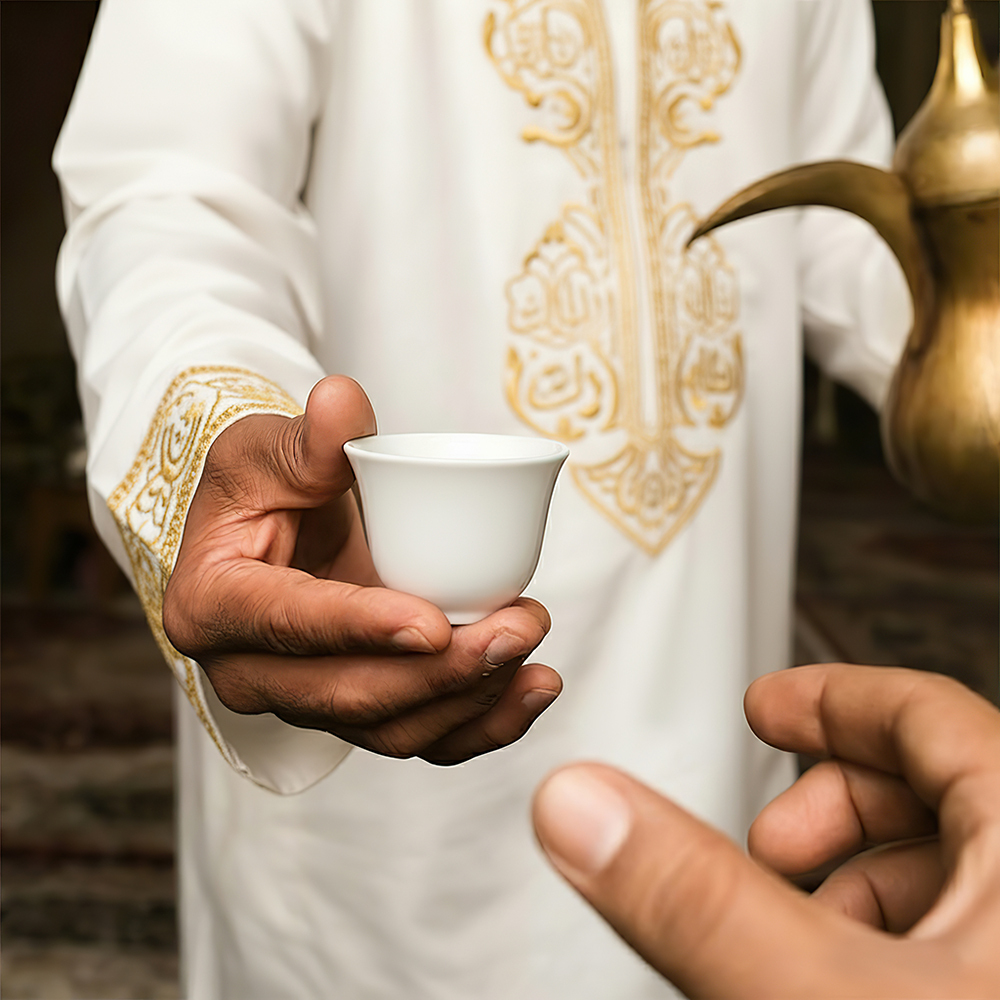
Explore how high-purity kaolin clay and 1,400C firing create fine European porcelain. Discover the science behind vitrification, translucency, and chip resistance.
For centuries across Europe, fine porcelain was guarded as a state secret and traded at prices rivaling precious metals—earning it the legendary name “White Gold.” While raw ceramic crafts have existed for millennia, genuine hard-paste porcelain requires a precise convergence of natural mineral chemistry and thermal science.
At the heart of every authentic piece of European tableware are two indispensable elements: high-purity kaolin clay and high-temperature kiln firing. Together, they transform soft earth into an ultra-durable, vitreous body revered by luxury hosts and fine-dining establishments worldwide.
1. Kaolin Clay: The Pure White Foundation
Not all clays are created equal. Common earthenware relies on iron-rich red or brown clays, but true hard-paste porcelain demands kaolin (often called China clay)—a hydrated aluminum silicate mineral ($Al_2Si_2O_5(OH)_4$).
Named after the Kao-ling hill in China where it was mined for centuries, kaolin possessed unique properties that European alchemists and craftsmen spent decades trying to replicate before unlocking rich deposits in Saxony, Limoges, and Meissen during the 18th century.
-
Refractory Strength: Kaolin has an extraordinarily high melting point compared to standard clays. It allows a vessel to retain its crisp structural shape in the kiln without melting or warping under intense heat.
-
Pure White Aesthetics: Devoid of heavy iron impurities, kaolin fires to a pristine, bright white shade—creating the perfect canvas for clear glazes, hand-painted details, and gold-rim embellishments.
-
Plasticity & Workability: When blended with quartz and feldspar, kaolin provides the ideal plasticity needed to press, cast, and hand-turn delicate dinner plates, teacups, and serving platters with razor-thin rims.
2. The Mineral Blend: Kaolin, Quartz, and Feldspar
Kaolin alone cannot create porcelain. Hard-paste European porcelain relies on a classic tri-axial formula, where each mineral serves a vital physical function during production:
-
Kaolin (45% – 50%): Provides the structural body, white color, and high heat resistance.
-
Quartz / Silica (25% – 30%): Acts as the skeleton, adding mechanical hardness and thermal stability.
-
Feldspar (25% – 30%): Acts as the natural flux, lowering the melting point of the silica and melting into liquid glass during firing.
3. The Magic of High-Temperature Firing & Vitrification
The true transformation happens inside the kiln. While basic ceramics are fired at modest temperatures, hard-paste European porcelain undergoes a two-stage firing process, with the final glaze fire reaching staggering temperatures between 1,350C and 1,450C, (2,460F – 2,640F)
Raw Clay Mineral Blend ──► Biscuit Firing (900°C) ──► Glaze Application ──► Grand Feu Firing (1400°C) ──► Fully Vitrified Porcelain
The Vitrification Phase
At these elevated temperatures, the feldspar melts into a molten glass phase, surrounding the kaolin fibers and silica grains. The minerals undergo vitrification—converting from crystalline clay minerals into a dense, non-porous glass-and-mullite matrix.
This thermal transformation delivers the hallmark characteristics of fine porcelain:
-
0% Porosity: The finished body absorbs zero water. It will never trap bacteria, absorb food oils, or stain from deep culinary pigments like saffron, coffee, or turmeric.
-
Translucency & Resonance: Held up to gentle light, high-fired kaolin porcelain allows light to pass through its thin walls, emitting a clear, bell-like musical tone when gently struck.
-
Mechanical & Chip Resistance: Despite its lightweight, graceful handling, the vitrified mineral matrix yields exceptional tensile strength and edge-chip resistance, making it suitable for both high-end private hosting and demanding commercial hospitality.
The Legacy of European Tableware Excellence
The marriage of high-purity kaolin and master-level kiln control represents generations of European manufacturing heritage. Understanding these material foundations reveals that fine porcelain is far more than everyday dinnerware—it is an enduring fusion of mineral chemistry, artistic legacy, and functional luxury.